

I stopped asking whether a product update was “good enough to post” and started checking four small cards instead. A clear ecommerce X post needs a known reader, one useful point, a believable proof detail, and an honest invitation to respond. If one card is blank, the draft is not ready—no matter how polished the wording looks.
That is the whole test. It keeps an update from becoming a feature list, and it gives a small team something concrete to discuss before the publish button enters the room.
The four cards on my desk
A product update usually begins as an internal sentence: “We shipped returns status in the customer portal.” Accurate, yes. Helpful to a store operator scrolling past it? Not quite yet.
I make the draft earn four answers:
- Reader card — who changes their next move because of this? Write a real role, not “everyone”: a support lead answering delivery questions, a merchant preparing a sale, or a customer deciding whether to buy.
- One-point card — what is the single useful change? Pick one consequence. Returns status is not “a better portal”; it is “customers can see progress without asking support.”
- Proof card — what concrete detail makes it credible? Use the actual screen, constraint, workflow, or release scope. Do not invent a number, promise a result, or borrow a customer story you cannot support.
- Conversation card — what could an informed person reasonably add? Ask about a trade-off or a familiar workflow. Do not finish with a hollow “thoughts?”
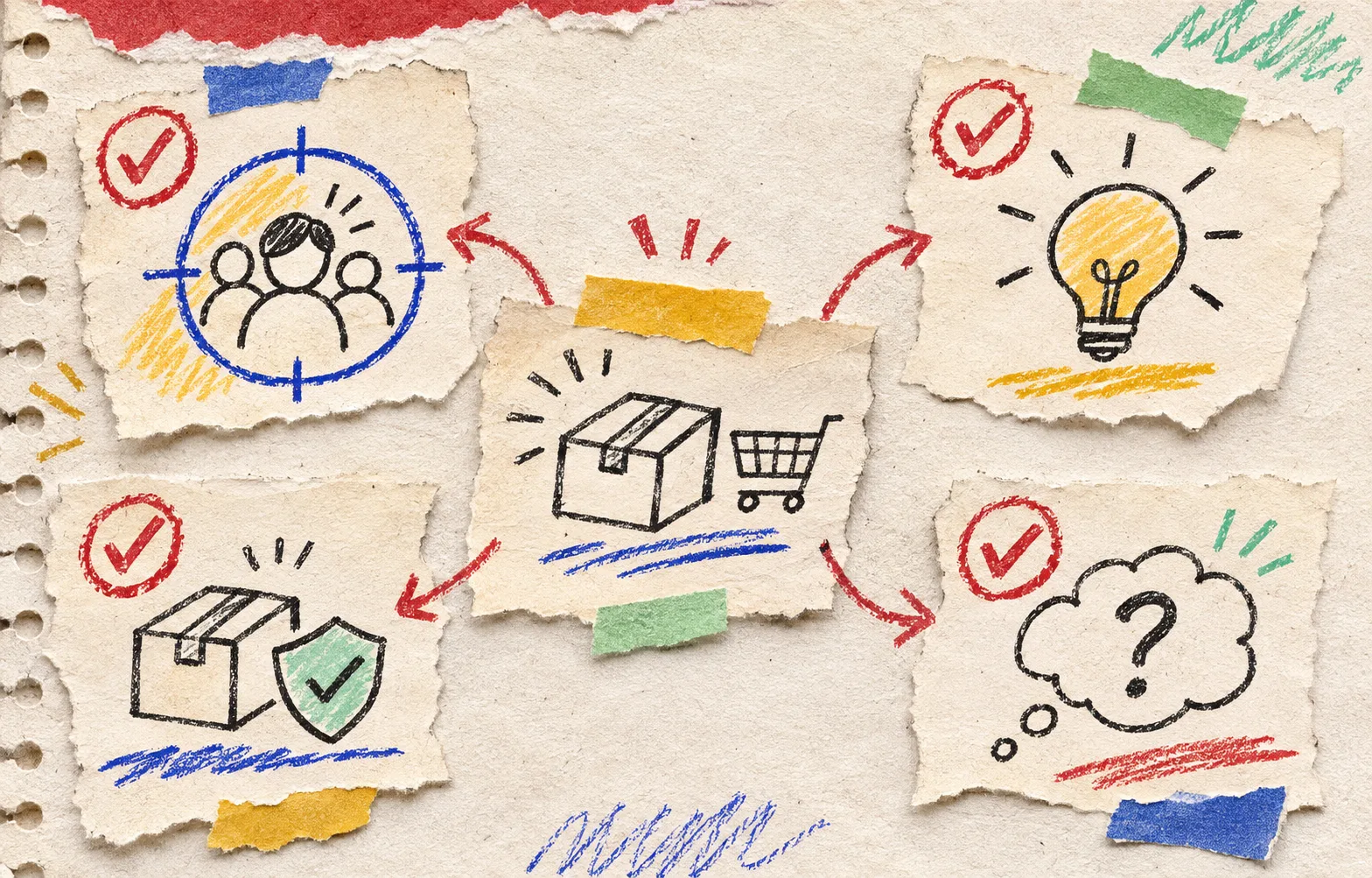
The cards are deliberately uneven. A small release might need one line for proof and two for the reader. The point is to expose missing thinking before a rewrite makes the gap sound smooth.
A worked rewrite: from release note to reader promise
Here is the rough note:
We shipped returns status in the customer portal. Customers can now see updates on their return.
Here is what the cards produce:
- Reader: support teams whose inbox fills with “where is my refund?” messages.
- One point: customers can check return progress themselves.
- Proof: the portal now shows the return status after the parcel is received.
- Conversation: which return-status step causes the most questions for your team?
A tighter draft could be:
The most repetitive returns question is often “did you get my parcel?” We added return status to the customer portal, so shoppers can see the next step after their return arrives. Which status update would save your support team the most back-and-forth?
It is still modest. It does not promise fewer tickets, better retention, or a transformed experience. It tells a reader what changed, where it matters, and leaves room for a useful reply. That restraint is part of the edit.
Where an AI rewrite belongs
I use Beastify after the cards, not before them. Its post improver analyzes a draft and returns several rewrite strategies; the public API documentation describes editorial scores for hook, clarity, specificity, curiosity, personality, and conversation. I treat those scores as prompts for discussion, not a prediction about reach.
The useful routine is:
- Write the unvarnished source note yourself.
- Fill the four cards from information you can stand behind.
- Ask for variants only after you know what must remain true.
- Compare the variants against the cards, then edit the strongest one in your own voice.
- Check the final link, image, and claim before posting.
That last step matters for any assisted workflow. In my release-receipt approach to a Notion-to-Webflow sync, the durable lesson was to keep a visible record of what was checked—not to confuse an automated action with a reviewed one. Social drafts deserve the same boundary.

Choose variants by failure mode, not by sparkle
When a tool offers three or four alternatives, I do not ask which one feels most clever. I label the original failure, then choose the variant that repairs it without replacing the point.
| If the draft fails because… | Look for a rewrite that… | Reject it when… |
|---|---|---|
| It opens with a feature name | starts with the reader’s situation | it exaggerates the pain |
| It contains three announcements | commits to one outcome | it hides necessary scope |
| It sounds generic | uses a real operational detail | it invents a metric or quote |
| It ends abruptly | invites a specific operational comparison | it begs for reactions |
This is the same reason I keep a change card before a Shopify bulk edit: a compact artifact makes the review conversation less fuzzy. The social version just fits on four cards instead of a spreadsheet.
A few hard stops help:
- Do not let a rewrite turn an internal estimate into a public claim.
- Do not use a meme merely because one is available. It should clarify a recognizable situation, and the post should still work without it.
- Do not replace your product’s language with generic “game-changing” language.
- Do not use an AI score as permission to skip factual review.
The final card: a conversation worth having
A useful ending gives the right people a small place to contribute. For a product update, that often means a workflow question: “Which return stage produces the most support questions?” For a technical launch, it might be: “What evidence would you need before trusting this automation?”
That is very different from trying to manufacture engagement. It invites a reply that can teach the team something. The distinction matters when a small business is building a public voice alongside its operations. I used the same principle when turning support patterns into clear X posts: the post starts with a real pattern, then gives readers a concrete way to compare it with their own work.

Use the card once today
Take the next product update waiting in your notes. Before rewriting it, write the reader, one point, proof, and conversation cards in four lines. Then try Beastify for alternatives if you want a quicker editorial sparring partner—but keep the cards beside the suggestions.
The version to publish is not the one that sounds most like a launch. It is the one that makes a specific, supportable promise to a real reader and leaves a useful door open for their experience.